
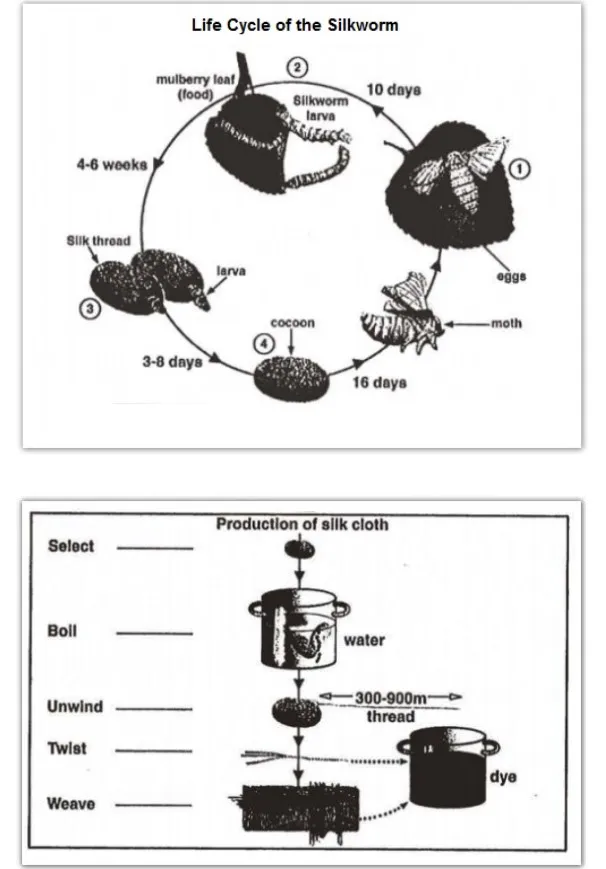
The diagrams illustrate both the life cycle of the silkworm and the stages involved in silk cloth production.
The life cycle begins when the female moth lays eggs, which hatch into larvae after approximately 10 days. During this stage, the larvae feed primarily on mulberry leaves for a period of 4 to 6 weeks. In the next stage, the larvae spin silk threads around themselves to form protective shells, a process lasting 3 to 8 days, and then develop into oval-shaped cocoons. The cocoon stage continues for about 16 days, after which the adult moth emerges. Once mature, moths reproduce, and the cycle begins again.
The second diagram outlines the process of silk cloth production, which involves more than five distinct steps. First, selected cocoons are boiled, allowing the long silk fibres to be unwound, each measuring between 300 and 900 metres. These fibres are then twisted into threads. The threads are dyed, woven into fabric, and often dyed again to achieve the desired colour and quality. In some cases, the twisting, dyeing, and weaving stages are repeated to produce high-grade silk.