
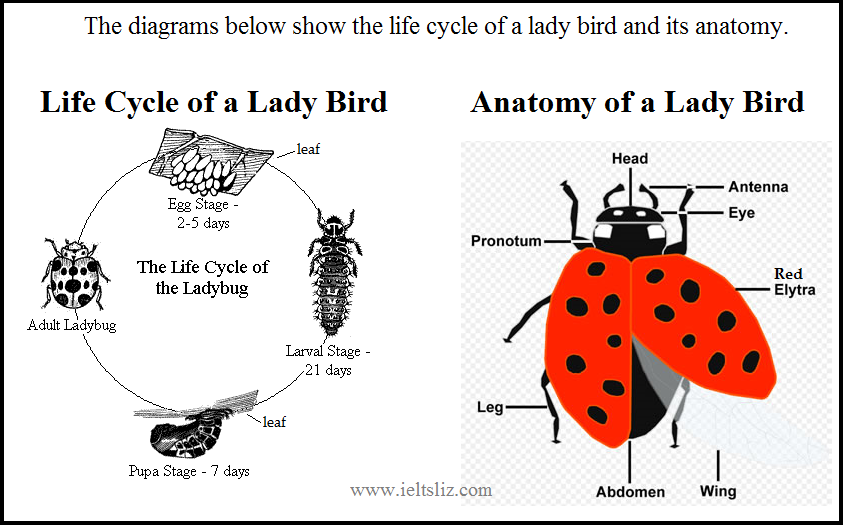
One diagram illustrates the four stages in the life cycle of a ladybug, while the other depicts its physical structure.
Overall, the development of a ladybug progresses through four distinct stages: egg, larva, pupa, and adult. The mature insect possesses six legs, a pair of wings protected by bright red elytra, and a head equipped with key sensory organs.
The cycle begins with the egg stage, which lasts for 2–5 days. Eggs are laid on the surface of a leaf, where they develop until hatching into larvae. The larval stage, lasting around 21 days, features an elongated-bodied insect capable of movement on six legs. Upon completing this phase, the larva attaches itself to a leaf and enters the pupa stage, which lasts about 7 days. At the end of this period, an adult ladybug emerges.
The adult ladybug is characterised by two wings, each covered by a red elytron marked with distinctive black spots. It has three pairs of legs attached to the thorax, an abdomen forming the lower part of the body, and a pronotum shielding the upper section beneath the head. The head contains a pair of eyes and two antennae, which serve sensory functions.