
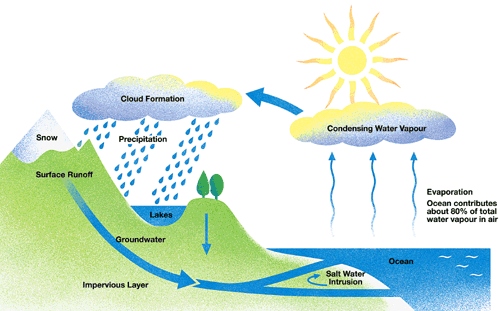
The diagram illustrates the natural stages of the water cycle, showing how water moves from the ocean to the atmosphere and then returns to the land and sea.
Overall, the cycle comprises four key stages: evaporation from surface water, condensation to form clouds, precipitation as rain or snow, and the return of water to the oceans through surface runoff and groundwater flow.
In the first stage, around 80% of water vapour originates from the oceans via evaporation, driven primarily by solar heat. This vapour rises into the atmosphere, where it cools and condenses to form clouds. These clouds eventually release precipitation, either as rain or snow, replenishing lakes, rivers, and snow-covered mountain peaks.
Following precipitation, part of the water infiltrates the ground and flows as groundwater, while the rest travels as surface runoff. Both sources ultimately return to the ocean, where surface runoff mixes with saltwater, completing the continuous and self-sustaining cycle.