
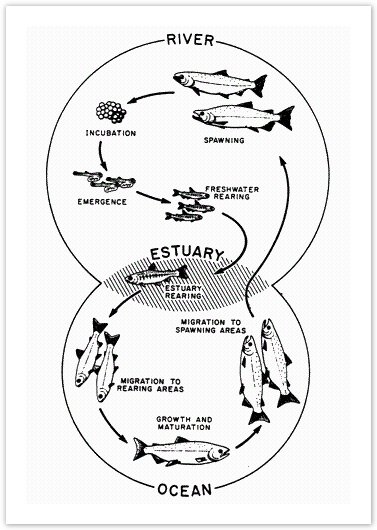
The diagram illustrates the life cycle of a salmon, outlining six key stages from egg to full maturity. Overall, salmon undergo a continuous process that spans three distinct habitats—river, estuary, and ocean—before returning to their place of origin to reproduce.
The cycle begins when adult salmon lay eggs in riverbeds, where the incubation stage takes place. Once hatched, the young salmon enter the emergence phase, remaining in freshwater to develop. During this period, they grow in size while adapting to their environment.
The next stage occurs when the juvenile salmon migrate to river estuaries, where they continue to grow and prepare for life in saltwater. As they mature, they move into the ocean, reaching full adulthood.
In the final stage, the adult salmon return to the rivers where they were born to spawn. After laying eggs, the cycle begins again with the next generation.