
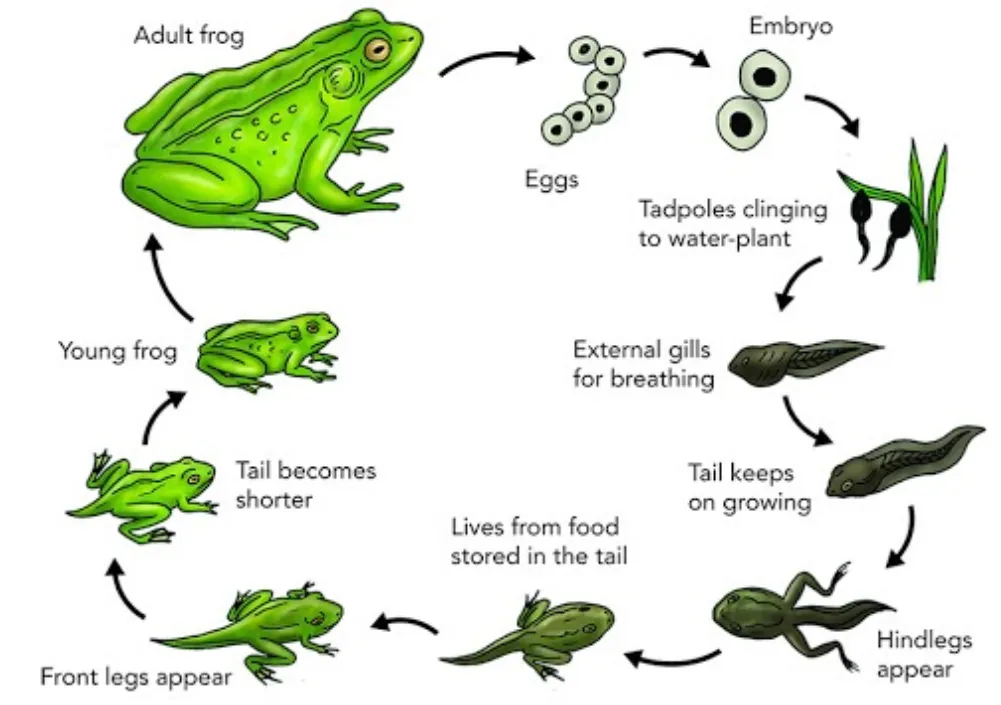
The diagram illustrates the sequential stages in the life cycle of a frog, from egg to fully mature adult.
Overall, this is a continuous, cyclical process comprising eleven distinct phases, beginning with the laying of eggs and culminating in the emergence of an adult frog capable of reproduction, thereby perpetuating the cycle.
The process starts when a female frog lays a cluster of eggs in water. These eggs develop into embryos, which subsequently hatch into tadpoles that attach themselves to aquatic plants. At this stage, the tadpoles breathe through external gills and have elongated tails, which provide stored nutrients for their growth.
As development progresses, the tadpole’s tail lengthens further before it begins to form front limbs—a key milestone in its metamorphosis. Over time, its tail gradually shortens, and the creature transitions into a juvenile frog, now capable of surviving both in and out of water. In the final stage, the young frog grows into a fully mature adult, able to reproduce and restart the cycle with the laying of eggs.