
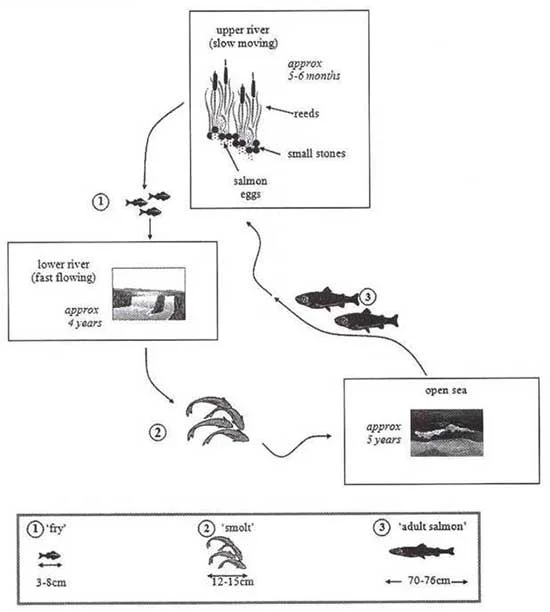
The diagram illustrates the six stages in the life cycle of a salmon. Overall, the process begins with eggs laid in a river and ends with the reproduction of mature adult salmon. The cycle can be divided into three main phases, each characterised by distinct physical forms.
The cycle starts when salmon eggs are laid on the riverbed in areas of slow-moving water, where they are protected by reeds and rocks. This stage lasts for around 5–6 months, after which the eggs hatch into small fish, known as fry, measuring approximately 3–8 cm in length. The fry migrate to faster-flowing sections of the lower river, where they spend about four years growing and undergoing slight changes in size.
Next, the salmon enter the smolt stage, reaching lengths of 12–15 cm. They then migrate to the open sea, where they remain for around five years. During this period, they grow significantly in size and develop their characteristic colouring. Fully mature adults, typically 70–76 cm long, then return to their original freshwater habitat to spawn. After reproduction, the cycle recommences with the next generation of eggs.