
| The charts show the changes in ownership of electrical appliances and amount of time spent doing housework in households in one country between 1920 and 2019. |
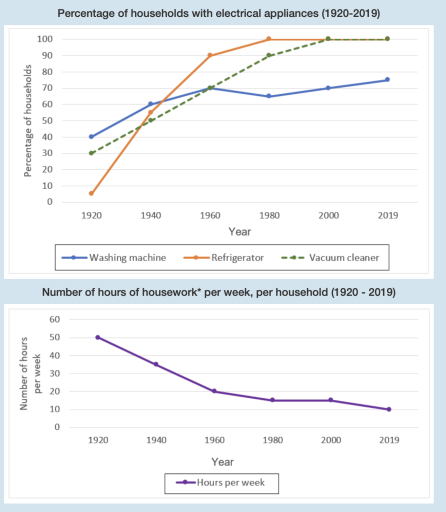
The charts show the percentage of households who own three types of electrical appliances: washing machine, refrigerator, and vacuum cleaner, and each household’s number of hours of weekly housework from 1920 to 2019. The rate of households with electrical appliances experienced upward trends in all appliances, while the number of hours of a household’s housework per week decreased gradually over the time period.
The rate of household with a washing machine was the highest among other appliances which appeared to be 40% in 1920. It was gradually increased to reach about 75% in 2019. The percentage of household who own a refrigerator was at the lowest in 1920, but the percentage was dramatically rose to 90% in 1960. There was a gradual increased of 10% in 1980 and, after that, the rate was stable until the end of the period.
The amount of time each household spend doing housework was 50 hours per week in 1920 and decreased steadily to 20 hours per week in 1960. Then, the amount of time reached the percentage 0f 10 at 2019.
1. Task Achievement (TA) – Band 6.5–7.0
Strengths:
- Covers both charts (appliance ownership and housework hours). ✅
- Gives overall trends (increase in appliances, decrease in housework). ✅
Weaknesses:
- Some data is inaccurately described: “percentage was dramatically rose” → grammar issue, “percentage 0f 10 at 2019” → unclear.
- Comparisons could be sharper: e.g., linking washing machine vs refrigerator trends, or connecting appliance growth to housework decrease.
- Lacks a clear, concise overview sentence highlighting the key features effectively.
Example Improvement:
- Original: “The rate of household with a washing machine was the highest among other appliances which appeared to be 40% in 1920.”
- Revised: “In 1920, washing machines were the most common appliance, owned by around 40% of households, while refrigerators were the least common.”
2. Coherence and Cohesion (CC) – Band 6.5–7.0
Strengths:
- Logical progression: introduction → trends → details. ✅
- Some linking words used: “while,” “then,” “after that.”
Weaknesses:
- Overuse of simple connectors; limited variety.
- Some sentences are long and unclear, reducing readability.
- Paragraphing could separate trends in appliances vs housework more clearly.
Example Improvement:
- Original: “The rate of household with a washing machine was the highest among other appliances which appeared to be 40% in 1920. It was gradually increased to reach about 75% in 2019.”
- Revised: “Washing machine ownership increased steadily from 40% in 1920 to approximately 75% by 2019.”
3. Lexical Resource (LR) – Band 6.5
Strengths:
- Uses some topic-specific vocabulary: “households,” “percentage,” “weekly housework,” “gradually.” ✅
Weaknesses:
- Repetition: “gradually,” “rate,” “percentage” used multiple times.
- Limited range of descriptive verbs: “increased,” “rose,” “decreased” could be replaced with “climbed,” “soared,” “dropped,” “fell steadily.”
- Some expressions are awkward: “appeared to be 40%” → “was approximately 40%.”
4. Grammatical Range and Accuracy (GRA) – Band 6.0–6.5
Strengths:
- Mostly correct subject-verb agreement: “The amount of time each household spend doing housework” (minor error: should be “spends”).
Weaknesses:
- Several errors with articles, plurals, and tenses:
- “The rate of household with a washing machine” → “The rate of households with washing machines.”
- “percentage was dramatically rose” → “the percentage rose dramatically.”
- “amount of time reached the percentage 0f 10 at 2019” → confusing and grammatically wrong.
- Limited sentence complexity; mostly simple sentences.
Example Improvement:
- Original: “The amount of time each household spend doing housework was 50 hours per week in 1920 and decreased steadily to 20 hours per week in 1960.”
- Revised: “Households spent 50 hours per week on housework in 1920, but this gradually declined to 20 hours by 1960 and further to 10 hours per week in 2019.”
Estimated Band Scores:
| Criterion | Band | Notes |
|---|---|---|
| Task Achievement | 6.5–7.0 | Covers the task, trends identified, some inaccuracies. |
| Coherence & Cohesion | 6.5–7.0 | Logical structure but limited connectors, some unclear sentences. |
| Lexical Resource | 6.5 | Appropriate vocabulary but repetitive and limited range. |
| Grammatical Range & Accuracy | 6.0–6.5 | Several errors, simple sentence structures. |
Overall Band Estimate: 6.5–7.0