
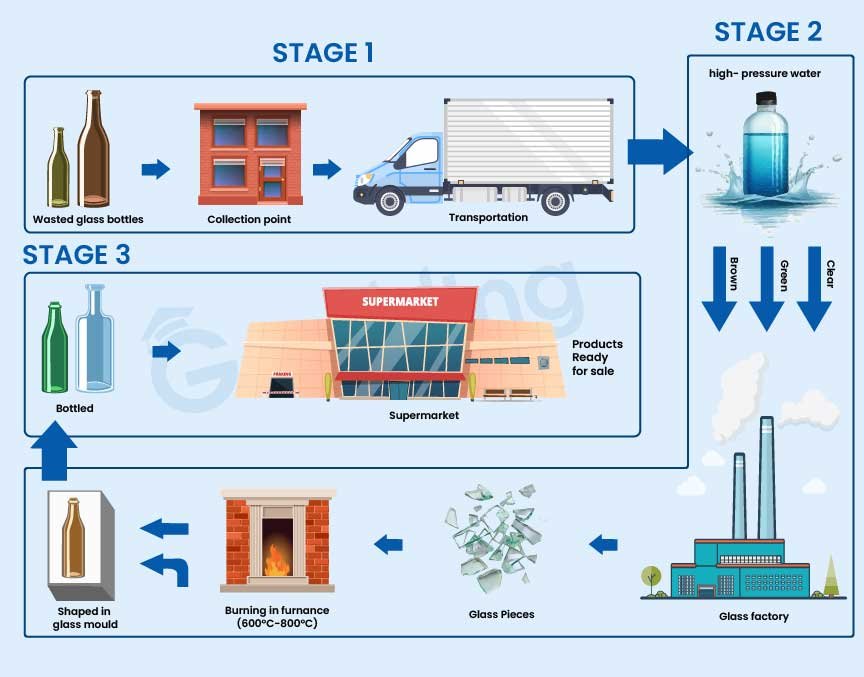
The diagram illustrates the stages involved in recycling glass bottles, beginning with their sale in supermarkets and ending with their return to the market.
Overall, the process comprises three main phases: collection, processing, and redistribution, transforming used bottles into new ones for consumer use.
In the first stage, glass bottles are purchased from supermarkets, used, and then discarded. These are gathered at designated collection points before being transported by truck to a cleaning facility. Here, they are thoroughly washed with water to remove any impurities. Once cleaned, the bottles are sorted into three categories—brown, green, and clear—and then sent to the recycling plant.
Next, the sorted bottles are heated until they melt, forming liquid glass. This recycled glass is then blended with new liquid glass to enhance quality. The molten mixture is poured into moulds to create new bottles. Finally, these newly manufactured bottles are transported back to supermarkets, ready for sale, thus completing the recycling loop.