
Band 9 Model Answer
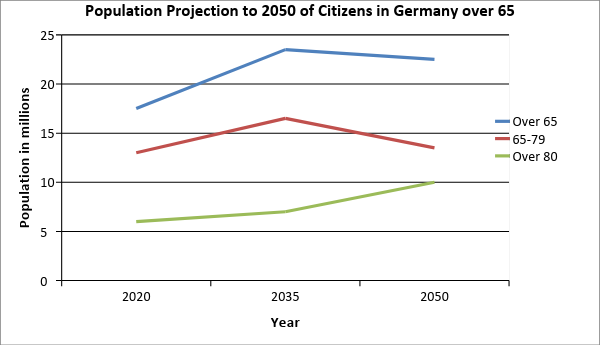
The line graph presents data on the population of German citizens in three age groups—over 65, 65-79, and over 80—over a thirty-year period from 2020, with projections up to 2050. The figures are given in millions.
Overall, the population aged over 65 is projected to remain the largest group throughout the period, while those over 80 represent the smallest segment. Notably, the over-80 age group is expected to show continuous growth, in contrast to the more fluctuating trends in the younger elderly groups.
In 2020, approximately 17 million Germans were aged over 65. This figure is forecast to rise steadily to about 24 million by 2035 before experiencing a slight decline to 23 million by 2050. Similarly, the 65-79 age group is predicted to increase moderately from around 13 million to nearly 16 million by 2035, then fall to approximately 14 million by 2050, remaining well below the total over-65 population.
In contrast, the number of citizens aged over 80 started at about 6 million in 2020 and is expected to grow steadily, reaching 8 million in 2035 and 10 million by 2050.
Examiner’s Comments & Breakdown
Task Achievement
- Strengths:
- Fully addresses all key data points and trends.
- Clearly distinguishes between the three age groups and their projected changes.
- Includes specific figures and dates to support descriptions.
- Tip: Avoid minor inaccuracies (e.g., “11 million fewer than civilians above 65” is confusing—better to clarify comparisons).
Coherence and Cohesion
- Strengths:
- Logical organization: introduction → overview → detailed data for each group.
- Effective use of linking words (“overall,” “similarly,” “in contrast”) for clear comparisons.
- Tip: Maintain consistent terminology (e.g., “Germans” instead of switching to “civilians”).
Lexical Resource
- Strengths:
- Good range of vocabulary: “projected,” “forecast,” “steady growth,” “moderate increase,” “continuous growth.”
- Appropriate use of formal language and numeric expressions.
- Tip: Use varied expressions for “increase” and “decrease” to avoid repetition.
Grammatical Range and Accuracy
- Strengths:
- Correct use of tenses to describe current data and future projections.
- Good mix of simple and complex sentence structures.
- Tip: Check spelling carefully (e.g., “steadily,” “respectively”).