
You should spend about 20 minutes on this task.
Summarise the information by selecting and reporting the main features, and make comparisons where relevant.
Write at least 150 words.
Model answer
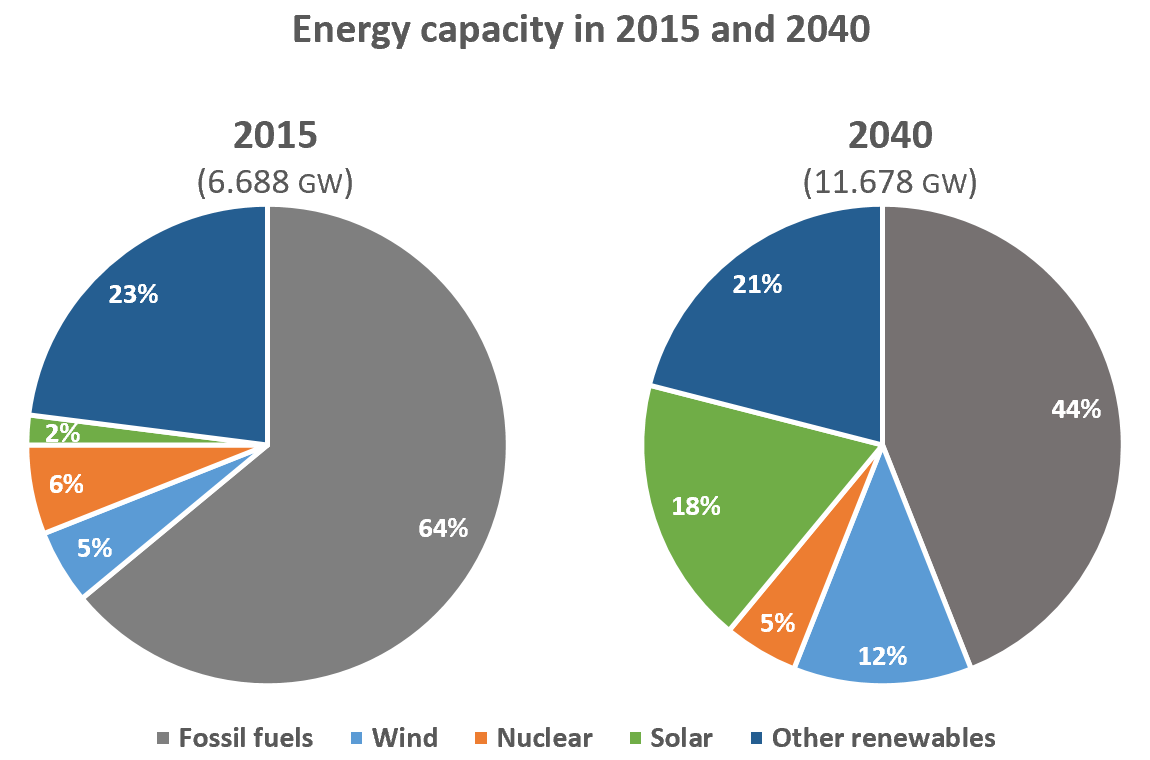
The charts compare the projected global energy capacity in 2040 with that of 2015.
Overall, fossil fuels are expected to remain the dominant energy source, although their share is predicted to decline considerably. At the same time, solar and wind energy are forecast to grow rapidly, while other renewables and nuclear power are projected to see slight decreases.
In absolute terms, total capacity is forecast to rise substantially, almost doubling from 6,688 gigawatts in 2015 to 11,678 gigawatts in 2040. Fossil fuels will still provide the largest share, but their contribution is predicted to fall from 64% to 44%. By contrast, solar power is expected to see the most dramatic increase, surging from only 2% to 18%. Wind energy will also expand, more than doubling from 5% to 12%.
Meanwhile, the proportion of other renewable sources is anticipated to decline modestly, from 23% to 21%. Nuclear power is forecast to make up just 5% in 2040, down slightly from 6% in 2015.