
Most test-takers fail to recognise that map questions aren’t about “describing” but about telling a story of transformation with geographical precision. The following method ensures Band 7+ by replacing uncertainty with mechanical execution.
A. Before you write:
Before you write a single word, you must categorize the map type. This determines your approach:
Type A: The Evolutionary Map (Most Common – 70% of questions)

- Characteristics: Shows development over time (e.g., 1980 → 2000 → 2020)
- Core Question: “How did this place evolve?”
- Focus: Chronological transformation, expansion patterns
Type B: The Comparative Map

- Characteristics: Shows two different locations or proposed plans
- Core Question: “How do these options differ?”
- Focus: Feature comparison, spatial relationships
Type C: The Building/Floor Plan Map

- Characteristics: Shows interior layouts or architectural changes
- Core Question: “How is space organized/reorganized?”
- Focus: Functional zones, access points, room purposes
Actionable Insight: Within 5 seconds of seeing the question, write “TYPE: [A/B/C]” at the top of your answer sheet. This primes your brain for the correct mindset.
PART 1: Understanding the Examiner’s Brain: What Are They Really Looking For?
Imagine you are an examiner. You have hundreds of papers to mark. You are not reading every single word with deep fascination. You are scanning.
You are looking for clear, instant signals that this candidate knows what they are doing. For maps, these signals are:
- A Clear Introduction: Did they just copy the question, or can they paraphrase it?
- A Visible Overview: Is there a separate paragraph that quickly tells me the main story of the maps? (This is the most important signal.)
- Logical Organisation: Is the description chaotic, or can I easily follow the order of changes?
- Grammatical Control: Are they using the correct tenses (past/present/future) and appropriate structures (like the passive voice) to describe changes?
If these four boxes are ticked within the first 30 seconds of reading, your answer is already in the Band 7+ range. The rest of the marking confirms that initial judgment. Our goal today is to make sure your paper sends these signals loudly and clearly.
PART 2: The Band 6 Trap: Why “Good English” Isn’t Enough
Many students with good vocabulary and grammar get stuck at Band 6 in maps. Why? Because they miss the strategy. Common Band 6 mistakes include:
- The “Tour Guide” Approach: “On the left, there is a shop. Then, if we go north, we see some trees. Behind the trees, there was a house…” This is disorganised and lacks overview.
- The “Memory Dump” Approach: Listing every single change in the order they see them, without grouping similar ideas.
- Tense Confusion: Mixing past and present randomly when describing the ‘before’ and ‘after’ maps.
- Missing the Big Picture: Describing lots of details but failing to step back and say, “Overall, this place became more built-up and modern.”
A Band 7 answer avoids these traps through a rigid, reliable structure. It feels calm and controlled. Let’s build that structure now.
PART 3: Your Unbeatable 4-Paragraph Blueprint
This is your safety net. Do not invent a new structure in the exam. Use this one for every single map question.
- Paragraph 1: Introduction (1 sentence) – “This is what I’m describing.”
- Paragraph 2: Overview (2 sentences) – “This is the main story.”
- Paragraph 3: Body Paragraph A – “This is what the area was like in the past/first map.”
- Paragraph 4: Body Paragraph B – “This is what changed and what it looks like now/in the future.”
This structure works for any map type: town development, building renovation, park upgrades, or island transformations.
PART 4: Crafting the Perfect Introduction (It’s Easier Than You Think)
Purpose: To show the examiner you have understood the task by rewriting the question in your own words.
The Mistake: Students waste 5 minutes trying to write a “beautiful” first sentence. Don’t. Efficiency is key.
The Band 7 Formula:
“The two maps depict/illustrate the development of [place] over a [time period] period, from [year/point A] to [year/point B].”
Let’s break down why this works:
- “The two maps” / “The provided diagrams”: A simple paraphrase for “the maps.”
- “depict / illustrate / show”: Simple, academic verbs.
- “the development / transformation / changes”: Good general words for what maps show.
- “over a… period”: A clean way to express the time frame.
Example: If the question says, “The maps below show the village of Chorleywood in 1868, 1883, and 1994.”
- Your Introduction: “The three maps illustrate the evolution of the village of Chorleywood over a 126-year period, from 1868 to 1994.”
Done. The examiner is satisfied. Move on.
PART 5: Writing the Overview – The Paragraph That Decides Your Score
This is the most important paragraph in your report. If it is missing or weak, it is very difficult to score above Band 6.
What is an Overview? It is a summary of the most significant, widespread trends. It does not contain specific details, numbers, or locations (e.g., “on the north side”).
How to Find the Overview (The 2-Minute Method):
- Look at the ‘before’ and ‘after’ maps.
- Ask yourself: “What is the BIG story here?”
- Usually, the story involves one or two of these common trends:
- Urbanization: Did natural areas (forests, farms) decrease while built-up areas (housing, roads) increase?
- Modernization: Were old facilities (small shops, dirt roads) replaced by modern ones (large stores, paved roads)?
- Expansion of Services: Were new amenities added (schools, hospitals, leisure facilities)?
- Improved Infrastructure: Were new roads/railways/bridges built to improve access?
The Band 7 Overview Template:
“Overall, it is clear that the area underwent significant development. The most notable changes were the transformation of [General Area A] into [New Function] and the expansion of [General Feature B].”
Example: For a map where a wooded park gained a café, car park, and playground.
- Your Overview: “Overall, it is clear that the park was modernised to accommodate more visitors. The most notable changes were the replacement of natural woodland with visitor facilities and the introduction of new recreational amenities.”
Now the examiner knows you can analyse. Your score is already rising.
PART 6: Body Paragraph 1: Setting the Scene (The Past/First Map)
Purpose: To describe the starting point clearly so that the changes later make sense.
How to Start:
- “According to the first map, in 1990,…”
- “In its original form, the island was…”
- “In 2000, the town centre was predominantly…”
What to Include: Describe 3-4 main features. Don’t list every single tree or bench. Use prepositions of place carefully (in the north, to the east of, in the centre).
Grammar Rule: Use the Past Simple tense consistently (was, existed, could be found).
Critical: The Bridge Sentence. End this paragraph by preparing the reader for change.
- “However, by 2010, the area had been completely transformed.”
- “Two decades later, significant redevelopment had taken place.”
This creates a smooth, logical flow that examiners love.
PART 7: Body Paragraph 2: Describing the Changes (The Present/Second/Future Map)
Purpose: To accurately and clearly report what was removed, added, replaced, and expanded.
The Golden Rule for Order: Describe changes in a logical, spatial order (e.g., from north to south, or from the centre outward). Do not jump randomly.
The Magic Grammar for Changes: The Passive Voice.
Why? We don’t know who built the road; the map just shows it was built. The passive voice is perfect for this.
- Additions:
was constructed,was added,was built. - Removals:
was demolished,was removed,was cleared. - Replacements:
was replaced by,was converted into,made way for. - Expansions:
was enlarged,was extended. - No Change:
remained unchanged,was not altered.
Structure Your Sentences for Clarity:
- One change, one sentence. Keep it simple and error-free.
- “The forest in the north was completely cleared.”
- “A new housing estate was constructed in its place.”
- “Furthermore, the main road was widened to accommodate increased traffic.”
- Use linking words to group similar changes:
Additionally,Furthermore,(for adding similar points).In contrast,While...(for comparing).
PART 8: Putting It All Together: A Complete Model Answer
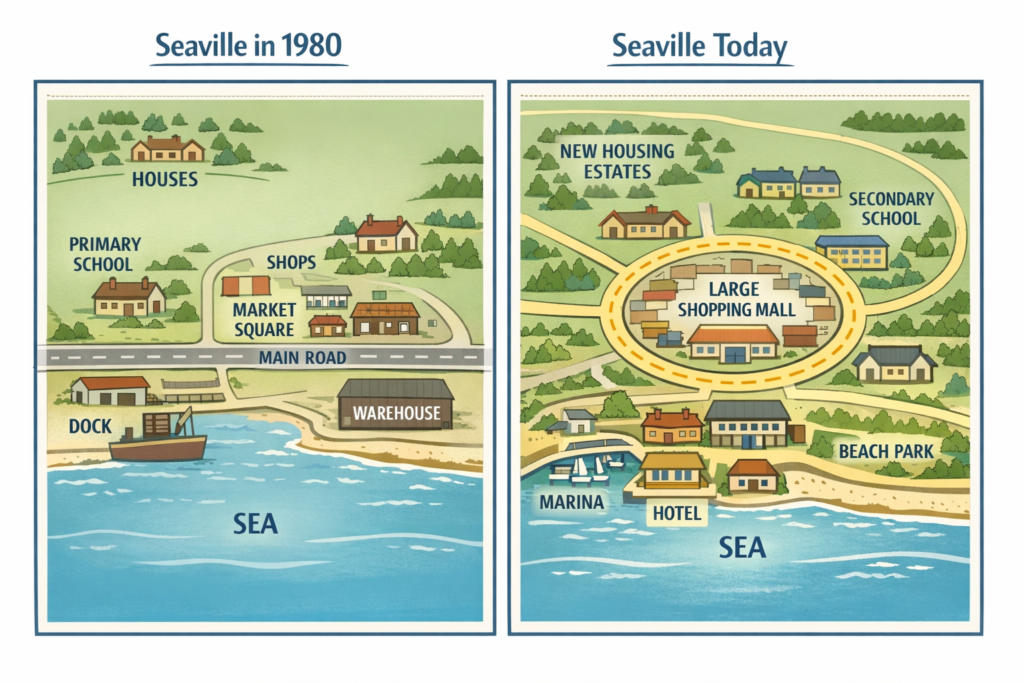
Task: The maps show the changes that took place in the seaside town of Seaville between 1980 and the present day.
(Paragraph 1 – Introduction)
The two maps illustrate the development of the town of Seaville over a period of approximately 40 years, from 1980 until the present.
(Paragraph 2 – Overview)
Overall, it is evident that Seaville was modernised and expanded to cater for tourism. The most significant changes were the transformation of the industrial coastline into a leisure-based area and the considerable expansion of residential housing.
(Paragraph 3 – Body 1: The Past)
In 1980, Seaville was a smaller town with limited amenities. The northern area was primarily residential, featuring houses and a primary school. The southern coastline was dominated by a dock and a warehouse. A single main road ran from the east to the west, passing through the town centre, which had a few shops and a market square. However, by the present day, the town had been radically redeveloped.
(Paragraph 4 – Body 2: The Changes/Present)
The dock and warehouse on the coast were demolished and replaced by a marina, a hotel, and a beach park. In the town centre, the market square was removed to make way for a large shopping complex. Furthermore, the residential area in the north was significantly expanded with new housing estates, and a new secondary school was built to serve the increased population. While the primary school and some original roads remained, a new ring road was constructed around the eastern perimeter to manage the increased traffic.
PART 9: Final Mindset & Action Plan
- Practice the Structure, Not Perfection: Do 8-10 map practice tests. Your goal is not to write a unique masterpiece each time, but to apply the same 4-paragraph system flawlessly.
- Timing is Key: Spend 3 minutes planning (find the overview trends, note key features). Spend 15 minutes writing. Spend 2 minutes checking (tenses, plurals, articles).
- Vocabulary: Don’t force in “advanced” words. Use the clear, precise language of change we’ve practiced. It’s better to be correct than to be fancy.
- Trust the System: On exam day, anxiety will try to make you panic. Your prepared structure is your anchor. Follow it step-by-step.
This lesson is your panacea, a reliable solution for every map question. The locations will change, but the method never will. Internalise it, practice it, and walk into your exam with the confidence of a Band 7+ candidate.